There are dozens of ways in which Apple’s apparent effort to build an Apple-branded car could go wrong, but there’s one argument against the idea that I’m hearing a lot of that really doesn’t make sense. From Henry Blodget to former GM CEO Daniel Akerson to the LA Times to Yahoo Finance people are saying this won’t work because the car industry is a “low margin” business in contrast to the fat margins Apple is used to earning most of all on its workhorse iPhone.
This might be the worst argument against the Apple Car

The misperception here is that Apple earns high margins because Apple operates in high margin industries. The truth is precisely the opposite. Apple earns high margins because it is efficient at manufacturing and firmly committed to a business strategy of sacrificing market share to maintain pricing power. If Apple makes a car, it will be a high margin car because Apple only makes high margin products. If it succeeds it will succeed for the same reason iPhones and iPads and Macs succeed — people like them and are willing to buy them, even though you could get similar specs for less.
Phones and PCs are low-margin businesses
Consider the smartphone industry, where Apple earns the lion’s share of the profit and revenue. Apple earns 93 percent of all profits secured by handset manufacturers, with Samsung earning over 100 percent of the remainder left behind. Which is to say that if you look at the non-Apple portions of the smartphone industry, it’s an exceptionally low-margin industry. Samsung is running a modestly profitable handset business based on enormous volume. Lots of players are losing money. Chinese upstart Xiaomi has a promising business built on handsets as a loss-leader for after-market services. By volume, the dominant software player in the smartphone industry is Google, which makes a phone OS that it gives away for free.
In other words, if Apple weren’t already earning tens of billions of dollars in smartphone profits, people might look at this landscape and say it would be pointless for Apple to get into the market. How are you going to compete with zero-margin handsets and a free operating system?
Well, it’s hard! But Apple pulled it off.

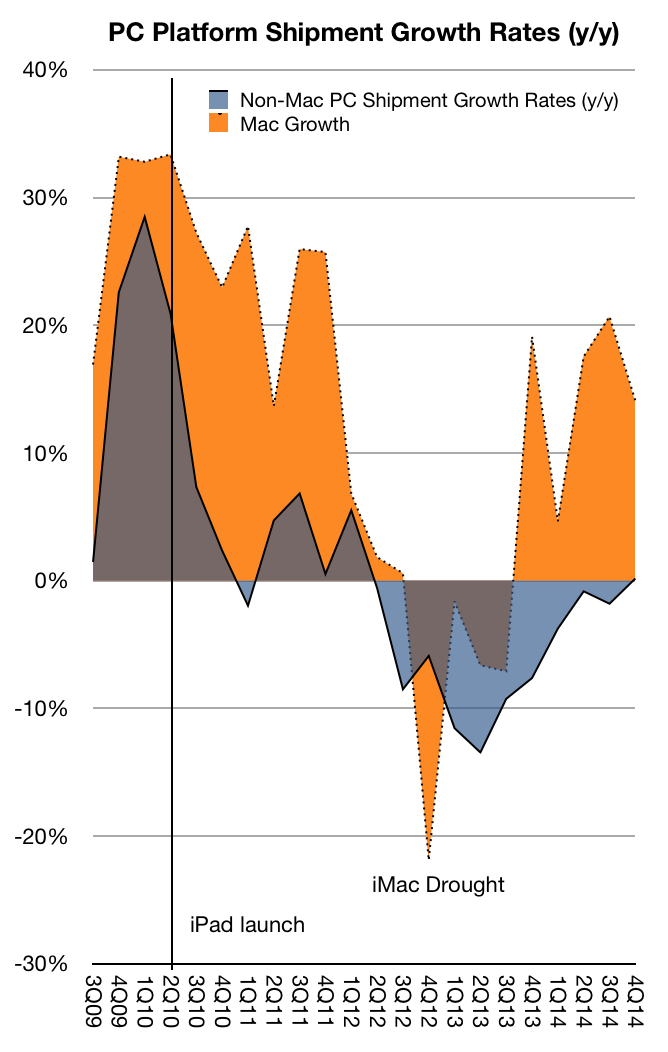
Apple isn’t as successful in the PC industry as in the smartphone industry, but it’s pretty successful and per Horace Dediu’s chart above, the story about margins is similar. As of 2012, the non-Apple parts of the PC industry were very low margin and Apple earned high margins anyway. And since that time, the Mac has only grown as a share of the PC market.
Margins as a strategy
These existing profit margins are so anomalous that people have frequently proclaimed them to be unsustainable. Others have simply regarded them as unwise, arguing that Apple’s long-term business would benefit from cutting prices to gain market share. But Apple is both fundamentally committed to this high margin strategy and good at executing it.
Will they be as good at executing it in the car space? Who knows.
But the logic that says Apple can’t have a high margin car business would also say Apple can’t have a high margin smartphone business. The reality is that earning profits in competitive industries is really hard. If you are looking for a guaranteed return, you need to be in a monopolistic industry (owning telecommunications networks or copyrights to popular comic book characters) rather than making consumer products.
Making an Apple-branded car is a big risk with a high chance of failure, but it’s not qualitatively different in that regard from making an MP3 player or a smartphone. If it were easy to do these things profitably, everyone would do it and the profits would be competed away. Apple’s entire success over the past 15 years is built on having defied those odds before, so you can understand why the company’s executives might think they can do so again.
See More: