At 10:59 pm Eastern on Saturday, January 9, there will be a Powerball lottery drawing for an estimated $800 million jackpot.
Powerball: What time is the $800 million jackpot drawing?

Photo by Scott Olson/Getty Images
That’s the biggest jackpot in history, even when adjusted for inflation.
Lottery jackpots have grown in recent years, with all 10 of the biggest nominal hauls coming since 2012 and inflation adjustments making little difference to the overall rankings.
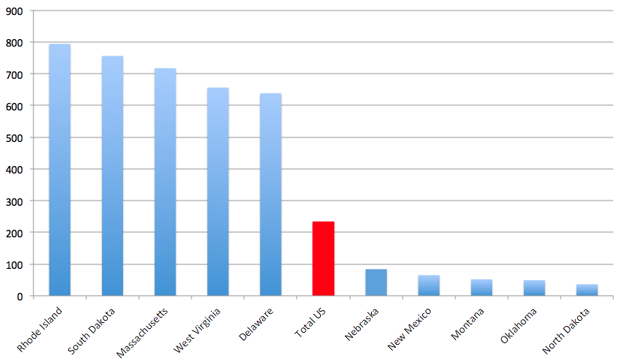
But by design these jackpots are small in comparison to the amount of cash Americans spend on lottery tickets. Total spending on lotteries amounted to a shocking $70 billion in 2014, which amounts to about $300 per adult.
As Derek Thompson wrote last year for the Atlantic, there is a tremendous quantity of state-by-state variation in lottery spending, with Rhode Island and South Dakota spending tremendous sums on a per capita basis while North Dakota and Oklahoma spend relatively little:

About 40 percent of lottery revenue is sent to states (often nominally earmarked for schools, but in practice money is fungible), and then winnings are subject to a hefty 45 percent windfall income tax, so the lottery is a major moneymaker for the government. In terms of revenue sources it’s one of the most regressive out there, with the poor buying a vastly disproportionate share of lottery tickets.
But a 2003 study by economist Emily Oster suggests that massive lottery jackpots may be more egalitarian in their distributive impact. Oster found that the regressive nature of the lottery as a revenue source is driven by the downscale demographics of very frequent lottery players. When jackpots get bigger, more people are induced to play, and the regressivity diminishes — though it doesn’t vanish.
Oster found that, hypothetically, a jackpot of about $806 million would likely be large enough to make the lottery progressive. Even this weekend’s record jackpot won’t quite reach that level, but it’s extremely close. And if there is no winner on Saturday, it’s possible we’ll have America’s first distributionally progressive lottery.
See More: