America’s prison population hit a new low in 2015 — even as the federal government failed to pass a highly anticipated criminal justice reform bill during the late years of President Barack Obama’s administration.
States have steadily cut prison populations since 2010 — without increases in crime
The US prison population hit a new low in 2015, the latest year with available data.
According to new data from the US Bureau of Justice Statistics, the overall prison population is still much higher than it was just a few decades ago. But the numbers suggest the incarceration rate is on its way down — and has been for years — after decades of increases.

The drop is even more pronounced when controlling for population growth over the past several years. In 2005, the incarceration rate was 492 prisoners for every 100,000 US residents. In 2015, it was 458 — a 7 percent drop. (In comparison, the overall prison population actually increased by 1 percent during this time period.)
States, with a focus on cutting prison time for nonviolent drug offenders, have led the way in the prison population reductions. The federal incarceration rate barely budged from 2005 to 2015 — moving from a rate of 56 prisoners per 100,000 US residents to 55. The state incarceration rate, however, fell from 436 to 402.
States have a huge role to play here: About 13 percent of US prisoners reside in federal prisons, while 87 percent are in state facilities.
Still, cuts in the federal prison population appeared to play a particularly big role from 2014 to 2015. According to the Bureau of Justice Statistics, drops in the federal prison population accounted for 40 percent of the prison population reduction in 2015. That’s in large part due to executive actions by the Obama administration to lock up fewer nonviolent drug offenders.
But if the trend toward less incarceration is to continue, states will likely need to keep leading the way. President-elect Donald Trump and Alabama Sen. Jeff Sessions — Trump’s nominee to head the US Department of Justice, which oversees federal prisons — have both taken “tough on crime” positions in support of longer prison sentences.
The good news for reformers is that states have so far managed to cut their prison populations while maintaining lower crime rates. That suggests it really is possible to reduce the prison population — and potentially save money that would otherwise go to criminal justice budgets — without putting the public at risk.
States are cutting their prison populations without increases in crime
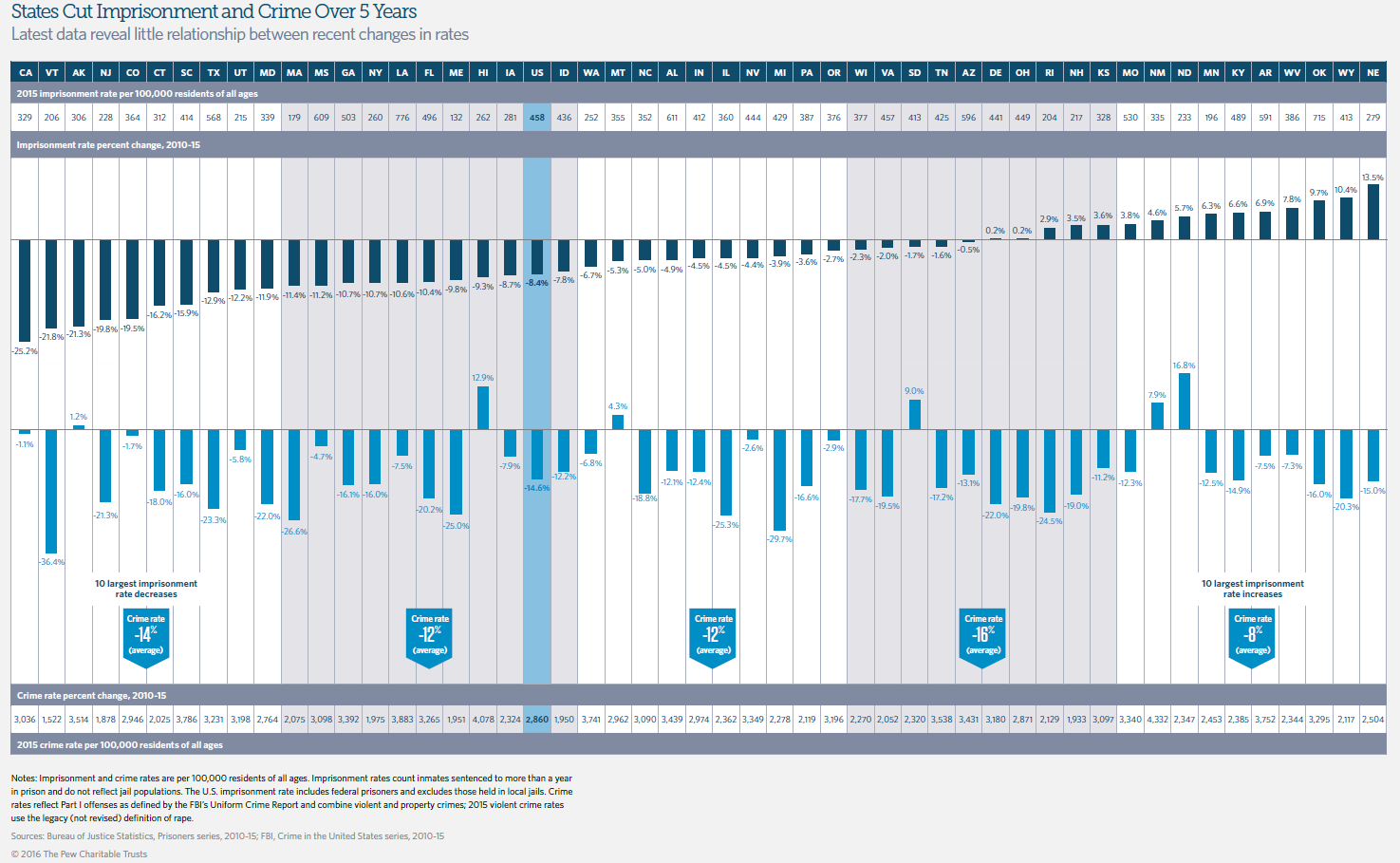
Along with the Bureau of Justice Statistics report, the Pew Charitable Trusts, which works to reform the criminal justice system, put out an analysis comparing changes in states’ prison populations and crime rates. Their big conclusion: There appears to be no connection between the crime rate and incarceration rate.
According to the report, “In the 10 states with the largest imprisonment declines, the crime rate fell an average of 14.4 percent, compared with 8.1 percent in the 10 states with the biggest growth in imprisonment.”
Here are all the states’ numbers in chart form (click here to enlarge):

The findings convey a lesson that’s now pretty well established in the research: Mass incarceration has played only a small role in reducing crime, which has fallen by about 50 percent since the 1990s. A 2015 review of the research by the Brennan Center for Justice estimated that more incarceration explained 0 to 7 percent of the crime drop since the 1990s, while other researchers estimate it drove 10 to 25 percent of the crime drop since the ’90s. (Other potential contributors to the crime drop include changes in policing strategies and reduced use of cash.)
At the same time, the US is the world’s leader in incarceration — imprisoning people at a higher rate than any country except the tiny African nation of Seychelles. This comes at a big cost: about $80 billion a year at the local, state, and federal levels.
Given these facts, states have sought to reduce their prison populations over the past few years. The latest data suggests they’re starting to succeed — all without exposing the public to a greater risk of crime.
See More: