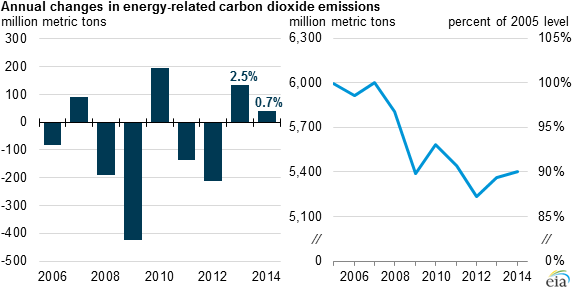
One of the most promising climate-change stories of the last decade was the steep plunge in US carbon dioxide emissions after 2005. Before then, US emissions had been rising relentlessly for decades. Suddenly, they were falling.
US carbon emissions are rising again. Can Obama push them back down?

That drop was partly due to the massive recession, which dampened energy demand. It was partly due to the US fracking boom, which created a glut of cheap natural gas and spurred utilities to burn less coal for electricity. And it was partly due to various clean-energy and efficiency measures.
Now, however, that progress is starting to stall out. The US Energy Information Administration reports that US carbon dioxide emissions from energy actually rose a bit in 2013 and 2014:

Overall, US carbon dioxide emissions from energy are still about 10 percent below the levels they were back in 2005. But emissions are no longer falling rapidly the way they used to. And that’s a potential problem for President Obama’s plans to tackle global warming.
After all, CO2 emissions from energy are the biggest component of America’s greenhouse gas emissions.* And Obama has pledged that US greenhouse gas emissions will be at least 26 percent below 2005 levels by 2025. For that to happen, emissions will have to drop much, much further — not just bounce around current levels.
So why did emissions rebound in 2013 and 2014? For starters, the United States is no longer in the throes of a massive recession that crimped energy use. The population is growing, businesses are expanding, and people are starting to drive their cars more. That means everyone’s burning more oil, coal, and natural gas — still America’s three dominant energy sources.
What’s more, coal is no longer declining as quickly as it used to. Coal is the most carbon-intensive of all fossil fuels, and back in 2007 it supplied 50 percent of the nation’s electricity. Then came the US fracking boom, which created a surfeit of cheap natural gas for utilities to use instead. By 2012, coal supplied just 37 percent of America’s electricity, supplanted by gas and some renewables. Since natural gas produces just half as much carbon dioxide as coal when burned for electricity, this caused CO2 emissions to plummet.**
More recently, however, coal has been making a quiet comeback. Natural gas is no longer as dirt cheap as it was during the early fracking years, which has allowed coal to rebound to about 40 percent of electricity generation by 2014. That has helped nudged emissions back up.
The EIA now expects that US carbon dioxide emissions will rise again in 2015 and 2016 unless new policies are put in place. The Obama administration, for its part, is trying to avoid that exact fate. Last year, the Environmental Protection Agency proposed a sweeping new regulation to crack down on carbon dioxide emissions from thousands of gas and coal power plants around the country.
The administration’s hope is that these new rules, once finalized, will start pushing carbon dioxide emissions back down again — so that the drop in emissions since 2005 doesn’t turn out to be a mere blip.
Notes
* To be more precise, carbon dioxide emissions from energy make up about 77 percent of US greenhouse gas emissions. There are also methane emissions from landfills, oil and gas wells, coal mines, and cow belches, plus nitrous oxide from agriculture and wastewater management. Plus a handful of fluorinated gases.
** Replacing coal-fired electricity with natural-gas-fired electricity reduces the amount of carbon dioxide generated per kilowatt-hour of electricity. But as some environmental groups have noted, the increase in gas fracking also has the potential to increase emissions of methane, another potent greenhouse gas. There’s a fair bit of debate and uncertainty over how much this extra methane offsets the reduction in CO2.